- Home
- About us
- Students
- Courses
- Research
- Library
- News & Events
- Gallery
- Contact
- Our Blog
Latest News

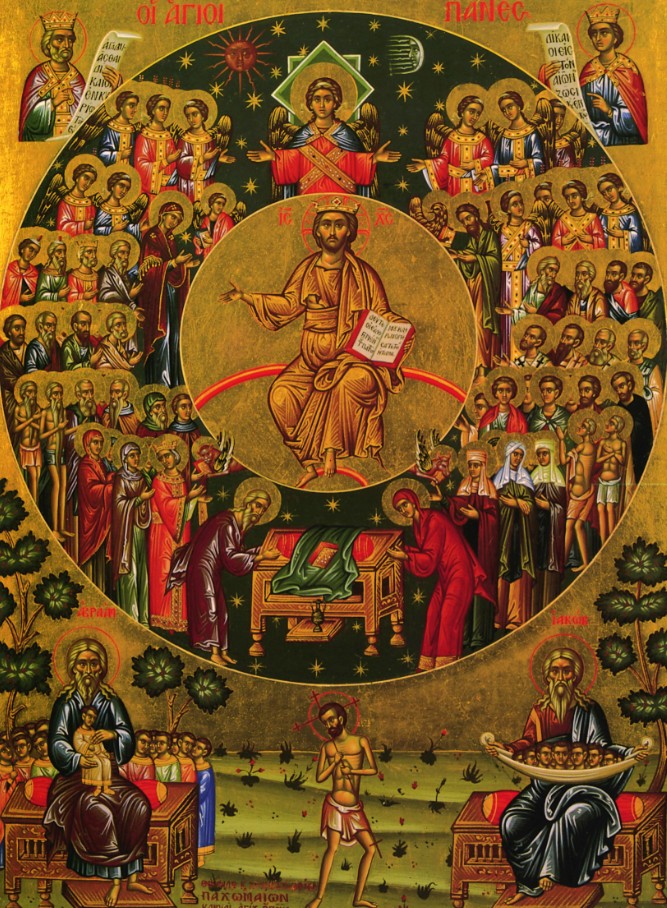
The Sunday of All Saints:
The Fruit of Pentecost
by Assoc. Professor Philip Kariatlis (Sub-Dean)
“By their virtues’ effulgent light, they made earth to be heaven-like and they imitated
the death of Jesus Christ. These are the ones who have walked the way that leads
to immortal life. By the surgery of grace, they removed human passions
as healers of mankind. And united throughout the world the Martyrs
have courageously contested. Let us extol all the Saints today.”[1]
On the Sunday immediately following the great feast of Pentecost, the Church celebrates the Feast of All Saints. At first glance, one might wonder why the Church has placed this commemoration at this particular point in the liturgical year. Yet this arrangement is neither accidental nor arbitrary. Rather, it reveals a profound theological truth at the very heart of the Christian life: the Feast of All Saints is the continuation, fulfilment, and visible manifestation of Pentecost.
Pentecost commemorates the descent of the Holy Spirit upon the Apostles. As Christ had promised before His Ascension, He did not leave His disciples as orphans but sent the Comforter, the Spirit of Truth, to abide with them and guide them into all truth (Jn 14:16–17). The coming of the Holy Spirit was not merely an isolated event confined to the Upper Room in Jerusalem; it marked the beginning of a new mode of existence for humanity.
It is precisely here that we discover the meaning of the Feast of All Saints. The saints are the fruit of Pentecost; or as hymn within the Vespers Service refers to them as “instruments of the Spirit [τοῦΠνεύματοςὄργανα].”[2] They are the living evidence that the Holy Spirit continues to dwell within the Church and transform human beings. What occurred in the Apostles on the day of Pentecost has been repeated throughout every generation of Christian history. The same Spirit who descended upon the Apostles came to dwell in the martyrs, the confessors, the hierarchs, the ascetics, the righteous men and women, and indeed in all those who opened their hearts to God's grace.
The saints are therefore not extraordinary individuals who achieved holiness through their own efforts. They are, rather, men and women who received the gift of the Holy Spirit, cultivated it and allowed that gift to bear fruit in their lives. They understood that apart from the grace of God they could do nothing. Their sanctity was not the result of self-sufficiency but of profound humility. They recognised that every virtue, every good work, every spiritual accomplishment was ultimately a gift from above.
This truth stands in sharp contrast to one of the great temptations of every age: the belief that humanity is the measure of all things [ἄνθρωποςμέτρονπάντωνχρημάτων], already seen to be characteristic of the ancient Sophist philosophical tradition. Modern society also frequently encourages humanity to place their confidence in their own abilities, achievements, and resources. The saints remind us that authentic life begins only when we cease focusing on ourselves and entrust ourselves entirely to God. No one can truly encounter the living God while remaining imprisoned within the confines of self-love and self-reliance.
Yet the saints are not only examples of humility; they are above all examples of love. Despite their diversity of backgrounds, cultures, personalities, circumstances, and vocations, they all shared one defining characteristic: they loved Christ above all things; they were “consumed by the Master’s love.”[3] Indeed, this is precisely what we hear in today's Gospel, where the Lord declares: “He who loves father or mother more than Me is not worthy of Me; and he who loves son or daughter more than Me is not worthy of Me”(Mt 10:37). Christ is not abolishing natural human love; rather, He reveals its proper order. The saints understood that every authentic love finds its fulfilment when rooted in love for Christ. It was this all-embracing love of Christ that captivated their hearts and permeated every aspect of their lives. Having discovered this, they were willing to relinquish everything rather than lose that communion of love.
Indeed, the saints were those whose hearts were irresistibly drawn towards Christ in love. The deepest longing of their souls was for union with Him. Their entire lives became a response to His invitation: “Abide in Me, and I in you” (Jn 15:4). At the same time, the love of God was inseparable from love for neighbour. The saints understood that one cannot genuinely claim to love the invisible God while remaining indifferent to the visible person standing before us. Their love for Christ manifested itself concretely in compassion, forgiveness, mercy, hospitality, sacrifice, and service. Their hearts were enlarged by grace and became capable of embracing others with the very love of God.
The Feast of All Saints ultimately proclaims a message of hope. The same Holy Spirit who descended upon the Apostles, who strengthened the martyrs, enlightened the Fathers, sanctified the ascetics, and glorified the saints, continues to dwell within the Church today. The age of the saints has not ended. Pentecost continues. The Spirit continues to act. And the path to holiness remains open to every person who, with humility and love, responds to God's call. For as Peter said to Christ, “We have left everything and followed You”(Mt 19:27), so too have the saints in every generation. And to them belongs the Lord's promise that those who leave all things for His sake will receive “a hundredfold” and “inherit eternal life” (Mt 19:29).
In celebrating All Saints, therefore, we celebrate not only the glory of those who have gone before us, but also the extraordinary destiny to which every Christian is called: participation in the very life of the Holy Trinity through the grace of the Holy Spirit. Pentecost is the gift of the Holy Spirit; All Saints is the revelation of what the gift of the Holy Spirit accomplishes in human lives; namely, when men and women love Christ above all things, confess Him before the world, take up their cross, and allow the Spirit to transform them into saints. Truly God is wondrous in His saints; let us always seek their intercessions; and may they continue to inspire us towards the joyous gift of Life to which they bore witness and which is a Life victorious over death.
[1]Lauds, Sunday Orthros Service, Feast of All Saints.
[2]Saturday Vespers for the Feast of All Saints, first Sticheron Hymn.
[3]Ibid, second Sticheron Hymn.
| About the Author |

Associate Professor Philip Kariatlis Sub-Dean of St Andrew's Greek Orthodox Theological College Associate Professor Philip Kariatlis is Academic Director and Associate Professor in Theology at St Andrew's. After taking an undergraduate degree in Theology from St Andrew's, he graduated from the University of Sydney with a degree in Arts, majoring in Modern Greek. He received a Master of Theology and a doctorate from the Sydney College of Divinity, where he studied under Professor Gerard Kelly. His doctorate was in the area of ecclesiology where he examined the notion of koinonia ... |
Useful links
Subscribe to our Blog!

Subscribe to our blog written by our Faculty and learn more about your Orthodox Christian faith
Connect With Us
|
|
|
|
Join Our |


.png)
Copyright © 2019 St Andrew's Greek Orthodox Theological College.
All Rights Reserved. | Website Terms & Conditions